Saturday, January 14, 2023

The Passing of Tom Gaspick

Tom Gaspick sadly passed away today in the early AM of January 14th after a short battle with Cancer. 

He will be missed and remembered by all those who loved him and all those he touched with his writing. 

Details of his funeral will be posted here when available. 

Friday, November 15, 2019

An Atrocious Pair Of Eyelet Pliers


There are cheap tools that are remarkably good value for the money, and then there are cheap tools that ought not to exist. Here's an example of the latter.


It's a pair of eyelet pliers, for crimping 11/64" inside diameter eyelets.[1] Overall length of the pliers is about 5 3/4". Moment length is about 4 3/8". That moment length is inadequate to yield sufficient leverage to successfully crimp an eyelet. Here's a view of an eyelet 'crimped' by the pliers.


Barely crimped at all. Here's a view of an eyelet crimped by a proper pair of eyelet pliers.


One wonders why the manufacturer of the pliers even bothered to make them.

I've been racking my brain to try to come up with a way to modify or re-purpose these pliers to some useful end, and I've come up empty. I think they're about to go in the garbage.

* * *

Note:

[1] Eyelet sizing is arcane. According to this chart, what I have here are #000 1/2 eyelets. (Between #000 and #00.)

# # #


# # #

Wednesday, November 13, 2019

A Florist's Shears Without A Closure Ring


I'm not certain that these are florist's shears, but that's what they look like to me.


They have a torsion spring tucked away in the pivot that makes them self-opening. What's missing is a closure ring at the end of the handles to close them up for storage. Let's see if I can fabricate a reasonable facsimile of a closure ring.

- - -

And here's the beginnings of a ring fashioned from 1/16" diameter steel rod.


Here's the tool with its ring installed and clamped up in a 'third hand' for soldering.


And here's the ring closed up with 60/40 tin/lead solder.


I used regular plumber's paste soldering flux to solder that.

Here's the tool closed up with its new ring.


And here's a close-up view of the closure ring doing its job.


It's not perfect , but it'll do what I need it to.

# # #


# # #

Saturday, February 23, 2019

An Ancient Ark-Les Automotive Switch


It's a four-position rotary switch with wire-wound resistors built into the rear of it.


Stamped on the metal shell is "ARK-LES"[1]. The Ark-Les brand is still with us, though their website is a disaster right now. Every link just brings up a bit of gibberish.

- - -

I suspect that this switch must have been meant to be the heater-blower speed control switch for the cabin of a car or truck.

I'm a bit baffled by the knob. The knob surely has to be removable in order for the switch's shank to be installed in a panel, but the knob is stuck fast. I'll try warming it with a heat gun and see if it pulls straight off.

- - -

Hmmm. That didn't work. There's no pulling the knob straight off, and it doesn't want to unscrew in either direction. This makes no sense. The knob has to come off in order for the switch to be installable.

So ok; let's try this. I'll clamp the knob in my mechanic's vise in such a way that I can pry up on the metal shell with the knob held in place.


Here goes.

- - -

And that worked. I managed to get the knob free.


Now the question arises, should I go further and separate the metal shell from the ceramic base? That risks fatiguing and breaking the fastening tabs, but what the hey, let's have a look inside.

- - -

And here we are with the components separated and lined up.


- - -

Uh-Oh

This switch has a defect. The centre resistors-connection crimp terminal at the rear is flaky. Someone has attempted to solder it in the past.


The solder didn't take to the resistance wire. I tried solder again after thoroughly scraping clean the area, but it was no go. Solder simply will not take to the resistance wire.

So, I centre-punched the connection all around to try and establish a renewed crimp effect.


That may work, though I'm not confident that it's a truly sound repair. I'll reassemble the switch and try it out with a small DC motor. If nothing else, I'll keep the switch as a curiosity.

- - -

It works. Here's an annotated schematic of the thing.


* * *

Note:

[1] A little play on words there, I imagine; ARC-LES = arcless. My schematic doesn't show it, but the switch is a make-before-break type, which I suppose would inhibit arcing as switch position is changed.

# # #


# # #

Friday, February 1, 2019

A Trailer Wiring Harness (Partial) And Module


I'd love to know what manner of circuitry is inside these things. What are my odds of opening up that encapsulated module? -- slim to nil, probably. Let's have a go.

- - -

And here we are.


Hmmm.

I did manage to split the thing open, but the component side of the circuit board is encapsulated to a fare-thee-well. So much for that bit of reverse engineering.

Electronics today may as well be magic -- it's utterly inaccessible.

# # #


# # #


Saturday, January 19, 2019

Electric Scissors


I can't recall ever having had the thought, "Gee. I sure do wish I had a pair of electric scissors." Electric scissors are not something that I've ever felt the need of. But that hasn't stopped some outfit from manufacturing them.[1]


There's no maker's name on it. It takes two 'C' cells in its battery compartment.


And it's inoperative; pushing the switch button results in nothing. Oxidized electrical connections are the likeliest fault.

Here's a view of the business end's insides.


A little DC motor with a cam at the end of its shaft lends a rocking action to one of the blades, and that provides the scissoring effect.

Some attention paid to electrical continuity got the motor going. Here's a brief video of the mechanism in action.


['Sorry about the very poor video. I could have used some help with shooting that, but there was none available.]

The swing of the moving scissor blade is tiny. Only a very small part of the scissors' blade length is actually utilized. But it does cut paper remarkably well. Here it is in action.


I'm kind of impressed.

The battery compartment cover wants attention; one of its retaining clips is broken and the cover pops open easily.

- - -

And here we are with a fastening for the wayward battery compartment cover.


That's a 4-40 x 3/16" screw with an oversize No. 4 flat fibre washer holding the front edge of the cover in place. That will work fine.

I'll keep the tool handy and see if it makes itself useful.

* * *

Note:

[1] And never mind just 'some outfit'. There are all kinds of the things available, and they're not cheap. Visit Amazon and search for "electric scissors" and you'll see what I mean.

# # #


# # #

Thursday, December 20, 2018

A GN-38-B Army Field Telephone Generator


It's a little the worse for dust accumulation, but it's in fine condition.


The things were built to last forever. This one still works as it ought to. Here it is cleaned up some.


I may put this up for sale on Kijiji. I can't think of any use to put it to.

# # #


# # #


Thursday, August 24, 2017

A Pair Of Roller Skates


Does anyone still skate with these, or is it strictly in-line skates now?


On the front portion of the skates' platforms is stamped "SIMPSONS-SEARS  MADE IN CANADA". Are those days ever long gone.

These may have belonged to my older sister; I have no recollection of having ever roller skated.

I think these are bound for my scrap metal pile.

# # #


# # #

Tuesday, January 24, 2017

A Dahlia Sprayer


Here's a new one on me -- something I've never encountered before.


It's a Dahlia Sprayer -- a sprayer/mister that you hand pump to pressurize. Apparently, these things are quite valued for the fine, dripless mist they produce. An outfit that sells them, Gaylord Archival, says this about them: "The Dahlia Sprayer has remained the standard handheld mister for many years. It is particularly well suited for relaxing paper and removing stains."

I tried out the one pictured and it works. It was made by the Maruhachi Industry Company of Tokyo, Japan. (If they're still a going concern, they don't appear to have a website.)

I'll stash this one in the storage room for now, along with some of my wife's gardening things. Perhaps she'll find use for it as some sort of plant mister.

# # #


# # #

Sunday, August 7, 2016

A Two-Prong To Three-Prong Adapter Cord


This short (under four feet) extension cord has a two-prong plug, and a three-prong receptacle. Why would anyone make such a thing?

The answer to that question lies in an obsolete form of house wiring known as 'knob-and-tube'. My dad's house had that type of wiring, and the outlets that accompany knob-and-tube wiring are two-prong outlets, not three-prong as with modern wiring.

So, to plug in a three-prong cord, one would need an adapter such as the one pictured here.

# # #


# # #

Monday, August 1, 2016

Gillette Safety Razors


Well, what have we here?


A couple of ancient Gillette safety razor kits, it turns out.


The one on the right is missing its blade box, and its lid is plain, except for the name "Gillette" embossed on it (now very faded).

The one on the left is complete and, as best as I can make out (it's very faded), says this on its lid:

"AVEC NOS COMPLIMENTS ALLUMETTES LAURIER"

Which translates to:

 "WITH OUR COMPLIMENTS
 MATCHES LAURIER"

The 'ALLUMETTES/MATCHES' bit makes no sense to me.[1] Possibly I'm misreading it -- it's very faded.

Anyway, here's the razor out of its box and assembled.


And here's a view of it completely dismantled.


That was high-tech shaving gear back in the day. (The things were made in Canada, by the way.)

There's a Wikipedia article on safety razors here.

I guess I'll stash these on the shelf where I keep my spare disposable blades.

- - -

Note:

[1] The "AVEC NOS COMPLIMENTS" bit seems to suggest that the kit was a promotional freebie, perhaps for guests at a high-end hotel in Quebec. Maybe "ALLUMETTES" has some obscure other usage, and doesn't only mean 'matches'. I just don't know.

# # #


# # #

Sunday, July 31, 2016

Two Honeywell Mercury Switches


There's a partial label on one of them, but all I can make out from it is that the maker was Honeywell.

The upside-down one at the left is in its open condition. The right-side-up one at the right is in its closed condition.

The bulbs are about two inches long, and there's a sizeable bead of mercury inside, so I imagine these switches have a substantial current rating. I don't know what they're from.

In the 1950s, my dad had a '55 Pontiac. I seem to recall that he used a switch like these to rig a rudimentary theft alarm in it.

He mounted the switch on the underside of the hood, and wired it so that if the hood were opened with the circuit armed, the horn would sound.

Mercury is a toxic waste bogeyman these days, so I'd be required to take these to the hazardous waste disposal depot were I to want to dispose of them. But I'm quite happy to hang onto them for possible use for something-or-other. I'll stash them in my 'miscellaneous switches' shoebox.

# # #


# # #

Saturday, July 30, 2016

Modern Gunsmithing by Clyde Baker


[This item wasn't really in the garage -- it was on my dad's bookshelf by his La-Z-Boy in his living room.]

- - -

"A Manual of Firearms Design, Construction and Remodeling, for Amateurs and Professionals"

by CLYDE BAKER

SECOND EDITION, 1933

Published by the SMALL-ARMS TECHNICAL PUBLISHING COMPANY, Plantersville, South Carolina, U.S.A.

- - -

It's quite a comprehensive volume.

Here's a paragraph from the opening chapter that can serve as an introduction to Mr. Baker's outlook:

"Work -- honest, decent labor, skill of fingers, accuracy of eye, -- somehow it seems to be beneath the present generation. The business man in his office sticks out his chest, holds "conferences," frowns and looks wise, preening himself on that thing he calls "ability." Then he sharpens his pencil by sticking it into a little machine and turning a crank -- or more likely screws down the point of an automatic gold one; has his finger nails cleaned by the blonde in the barber shop; calls a service man to change a tire on his car; wears a little useless penknife on his watch chain and sends it to a grinding shop to be whetted! -- yes, he does just that. We've been pampered now to the point of helplessness -- and if we don't watch our step, we'll find ourselves at the point of uselessness."

Bear in mind that those thoughts date from the early 1930s. What would Mr Baker think of today's automated world?

There's a brief  biographical item on Mr Baker here.

# # #


# # #

A Paring Knife With A Really Cheap, Broken Plastic Handle


On the blade it says, "STAINLESS STEEL JAPAN". The blade actually looks pretty good -- it's very nicely ground.

The handle is another story. What a piece of junk.

Knife handle making is something I've never pursued, but this knife might be worth making a decent handle for. We'll see.

Meanwhile, I'll stash this in my spare tools drawer.

# # #


# # #

Friday, July 29, 2016

A Burndy Wire-Mike


These are quite a neat electrician's caliper. It appears that Burndy still carries them.

I'll keep this in the cabinet where I have some other miscellaneous measuring tools.

# # #


# # #

Thursday, July 28, 2016

A Pair Of Nippers


They're in decent condition, and reasonably well made. There's a logo on each arm that says "18C", along with a tiny, indecipherable figure. I can find nothing to clue me in about the logo.

Anyway, nippers like these are not something I have much use for. I'll stash them in my spare tools drawer.

# # #


# # #

A Wee Spanner


There's no maker's name on it.

It's very thin -- only 1mm thick. The wrench end is 7/32". The small end may be for turning some sort of dimpled screw head or the like.

Perhaps it's for something like drapery track hardware -- who knows.

Anyway, I'll stash it in the drawer where I keep things like odd little spanners.

# # #


# # #

A Cheapo Pencil Compass From Hong Kong


It's not what you'd call a 'fine instrument', but it has a clever feature for gripping the pencil.

Note the little downward-pointing lever at the extreme right. That lever operates an eccentric that clamps the pencil into its barrel.

Here's the lever in its upward-pointing position.


The pencil is now quite firmly gripped.

The flaw in this design lies in the attachment of the pencil barrel to the pencil arm -- it's loose. That makes for a shaky, wobbly pencil arm.

Were I to super-glue the barrel to the arm, I might have a reasonably good, useable compass. Maybe some day when I'm really desperate to glue something, I'll do that.

Meanwhile, this can go in my spare tools drawer.

More To The Story

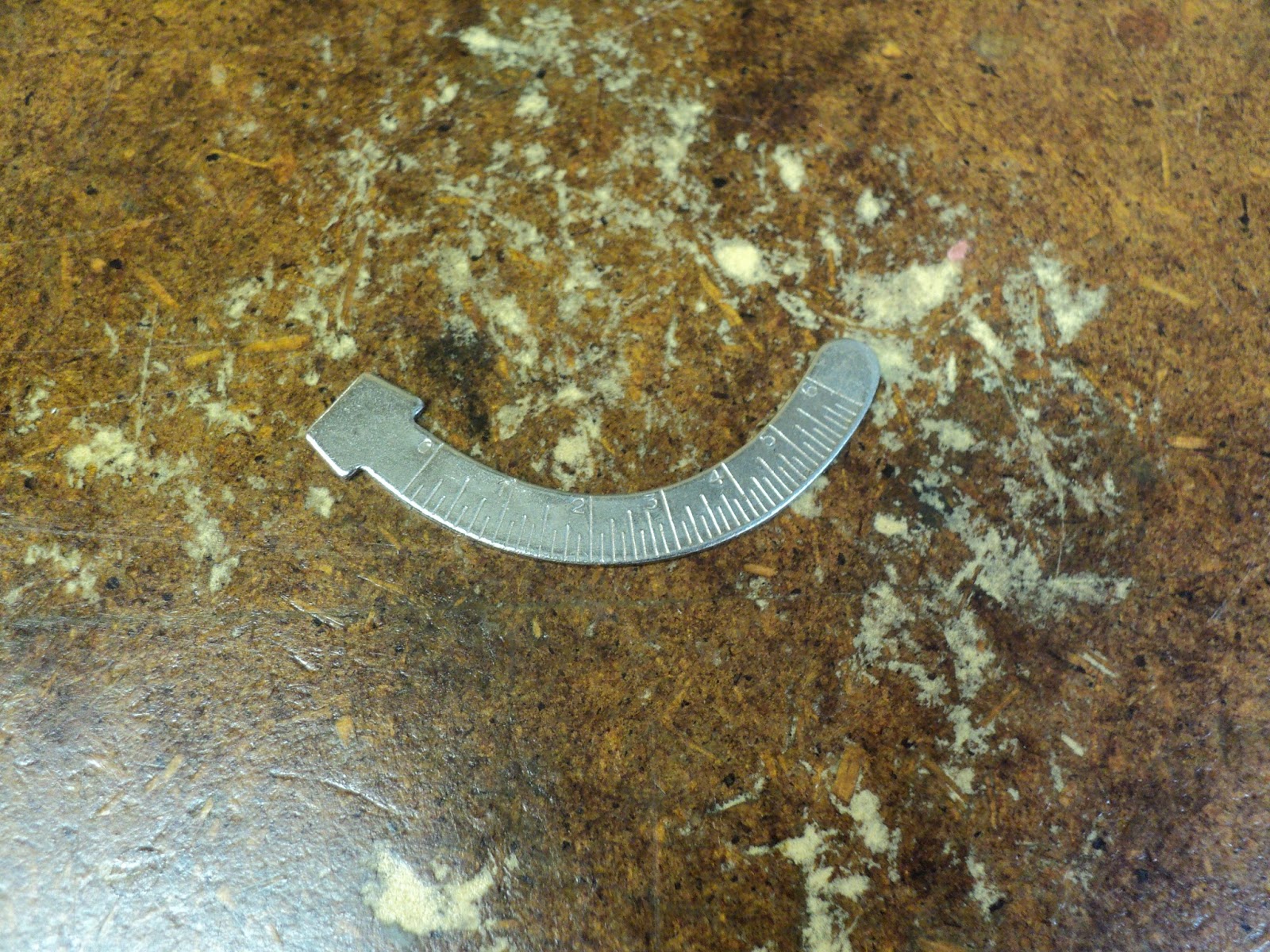
In the bottom of the small toolbox that the compass was in, I found this curious little loose part.


Hmmm. Might it be a radius or diameter scale that belonged to the compass? 'Sure looks like it.


Let's see if I can get this all back together. It might be interesting to see how accurate the scale is.

- - -

And here we are.


It's a radius scale, alright -- an outrageously inaccurate one.

Setting it to 1" gives me a radius of about 1 5/16". One wonders why the manufacturer even bothered.

# # #


# # #

A Straight-Handled Tap Wrench, Possibly


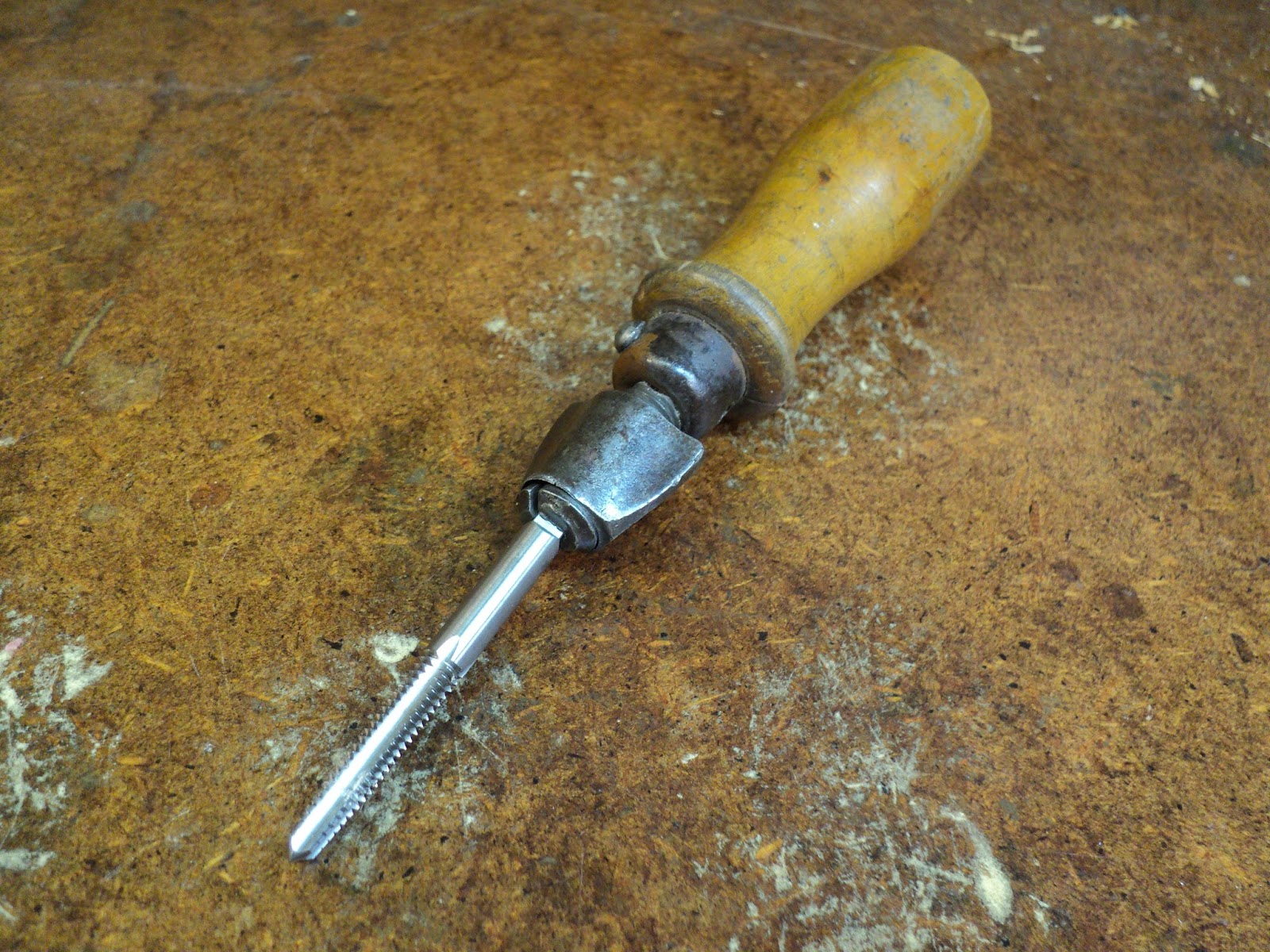
There's no maker's name on it. I can't think what else it might be but a tap wrench. It has a square-opening, two-jaw collet chuck on it. Here's a view of the chuck opened up.


And here it is fully closed. (By the way, the chuck's collar thread is left-handed.)


It closes down to about a 5/32" square.

Here it is holding a 1/4"-20 tap.


For light work like thread chasing, I've long preferred a straight handle to a T-handle -- a T-handle is needlessly clumsy when not much torque is needed.

I'll stash this in the drawer where I keep all my thread-cutting gear

# # #


# # #


A TradeMaster Crimping Tool With Metric Screw Cutting


Yeehah! I've finally got a crimping tool that cuts metric screws.

As I find myself using metric screws more and more often, I've been wanting to acquire a metric screw cutting crimping tool, but they seem to be rare birds indeed. This fills the bill nicely.

The screw sizes it takes are:
  • M2.5[1]
  • M3
  • M3.5
  • M4
  • M5[2]
As far as I know, TradeMaster is a Home Hardware house brand. I checked Home Hardware's website, and this tool appears to no longer exist.

Anyway, this can go straight into the drawer where I keep all my other crimping/screw-cutting tools.

- - -

Notes:

[1] The marking on the tool looks like 'M2.6', but there's no such thing that I'm aware of. It must be M2.5.

[2] M5 is just slightly larger than inch No. 10, and No. 10 screws take a lot of force to cut. You'd really have to squeeze for all you're worth to cut M5 screws.

# # #


# # #